The Hitachinokuni Long Trail
The Hitachinokuni Long Trail is a 200-mile/320-km long trail that spans six cities and towns in northern Ibaraki Prefecture at the northern tip of the Kanto region. What kind of nature, people, and culture exists here? By hands of Mr. Ikuo Wada, we were able to discover more about these amazing trails, and we participated in a Trail Work journey together with Nnormal Japan.
Meeting Ikuo Wada
Ikuo Wada, the head of the Hitachinokuni Long Trail project, has spent a long time in the field. Growing up, family vacations meant mountain climbing and skiing with his father. As a student, he traveled abroad backpacking and learned about many different people and cultures. He has also enjoyed backcountry snowboarding, surfing, and running as a trail runner, and is the course director for the OSJ Oku Kuji Trail. So we fully agree that he is a key person in “Hitachinokuni.”
How it started
“Walking a long trail and spending a long time there, one can get in touch with the nature, people, and culture of the area. And you can take that journey again and again, anytime you want. This is how I began to think about it, and this is how the Long Trail project was born.”
It was about eight years ago that Mr. Wada came up with the idea of a long trail in Ibaraki Prefecture. Regional development had long been an issue in the northern part of Ibaraki Prefecture, and camping events were often held as a measure to address this challenge at the time.
“The events were often exciting, but when they ended, the participants naturally left. There was not much left there, and I felt a bit sad. At such times, as a hiker and as a runner, I felt like I was traveling from village to village on ancient and abandoned roads – how about developing this further and including new routes to create a long trail that goes around the northern area of the prefecture that has never been done before? How about creating a “long trail” around the northern area of the prefecture that has never been done before, including a new route?”
Scenery of “Hitachinokuni”
With this in mind, Mr. Wada began full-scale maintenance of the Hitachinokuni Long Trail in 2020 collaborating with Ibaraki Prefecture, Japan. Runners, hikers, and community members have joined the club to regularly meet once or twice a month to carry out these activities, which have now expanded to the “Hitachinokuni Trail Club” with more than 800 registered members. As of spring 2025, about 85% of the trail (about 275 km) has been completed, and the entire trail is scheduled to open to traffic between 2025 and 2026.
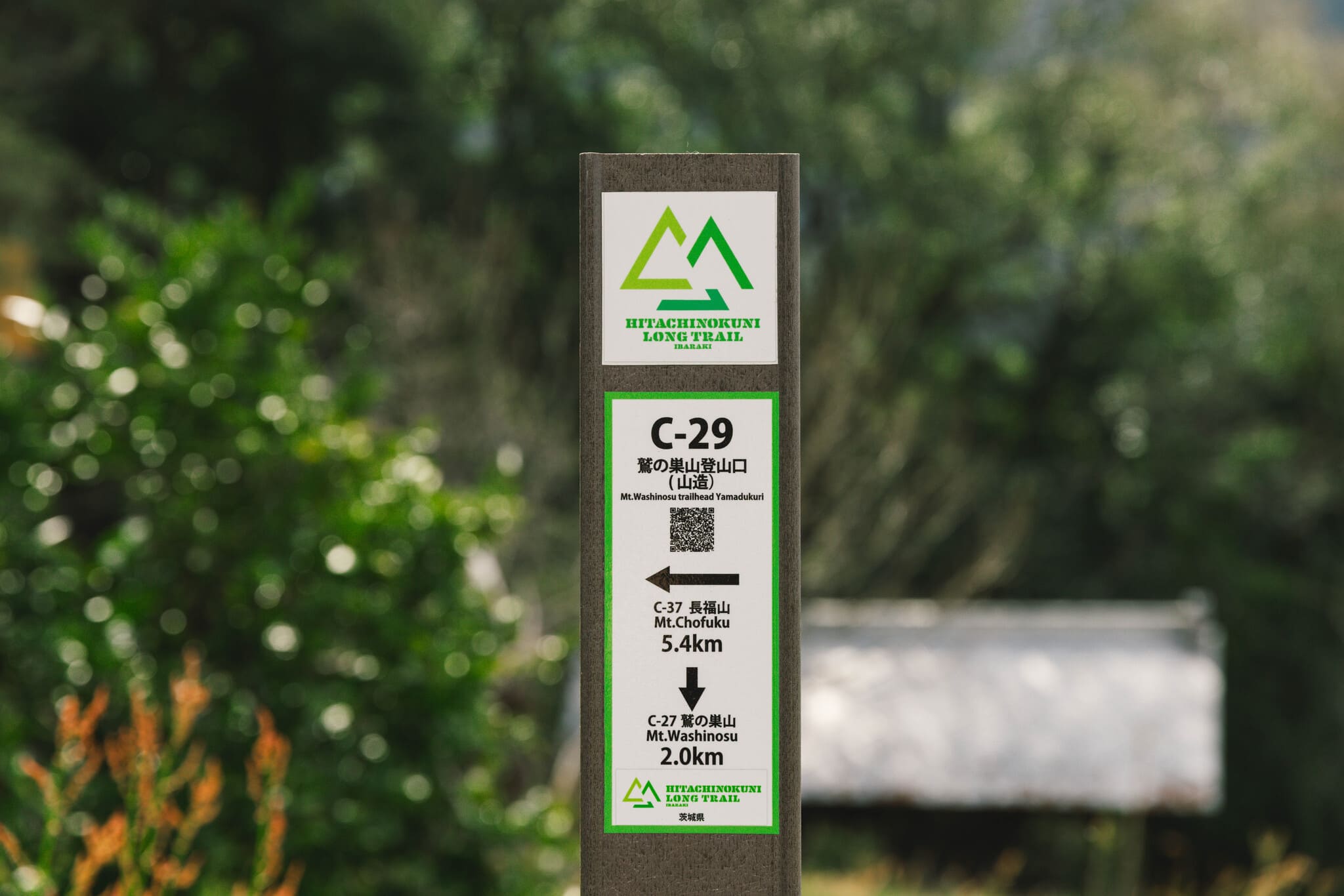
It was when we passed the “C-29 Mt. Takanosu Trailhead” sign on the Hitachinokuni Long Trail and joined the “Trail Club” members on the uphill trail. Mr. Wada told us this story.
Ikuo Wada explains:
“This area is the southern limit of apple cultivation and the northern limit of tea cultivation. Because Ibaraki was close to Edo, a capital of ancient Japan in the old days, we were able to take what we could pick to Edo right away. So there was no need to brand apples and tea. That is why Ibaraki’s crops are often inconspicuous, but in fact, the land is rich in vegetation, fruit trees, crops, and rice. You can sense this today just by walking around this area.”
Images by @hirotomiyazaki.jp
As you enter the trail, you can also see that there are lacquer trees. They say they are famous for their very high quality lacquer. From Mt. Takanosu, one can see a river running through the area, a village, and people growing crops unique to the area. Cedar plantations can be seen on the right side of the trail, and untouched forests on the left. One can concretely experience a landscape where people and nature have coexisted in harmony, just a short distance along the trail.
The nature and history unique to the area are everywhere on the Hitachinokuni Long Trail. It is not a passing event or fad, but an activity that has always been there and will continue to be passed down as part of the culture.
What makes the scenery along the Hitachinokuni Long Trail so special?
“For example, at the end of the “NE” section, the course opens up to the Pacific Ocean side and there is a section called ‘Hamakkaido’ (old beach road). If you walk there before dawn, it is indescribably and truly beautiful, with the sky and coast dyed bright blue before the sun rises. It is an extraordinary view unique to long trails that can only be seen by walking in Hitachinokuni and trekking at that time.”
So, what does it really mean to maintain trails that offer such a view?
“Trail maintenance is an activity to protect and preserve the natural environment, but I believe it is more than just work. By going from village to village, we can learn more about the lives of people in the past, their legends, and historical remains. We come to understand more about the people who live there now. I think the attraction of walking the Hitachi Long Trail is that it allows us to experience many small emotions, such as the movement of the heart, through trail maintenance.”
Hitachinokuni and the Restore the Trails project
The restoration of the Hitachinokuni Long Trail is part of the Kilian Jornet Foundation’s global effort to protect mountain environments. Through its Restore the Trails program, and in partnership with NNormal under the 1% for the Planet initiative, KJF works with local communities to identify and rehabilitate damaged natural areas.
As part of its 2025 global strategy, KJF is expanding activities to six countries, including Japan, where it now supports the Hitachinokuni Long Trail. The foundation provides both material support and collaboration with local teams. On this trail, around 15 volunteers led by Mr. Wada cleared fallen trees and maintained the route to preserve its natural beauty.
Mr. Wada emphasized that trail maintenance fosters personal awareness and a deeper understanding of nature, describing it as a way to “move your mind” and connect with landscapes on a more meaningful level. The partnership between KJF and local actors shows how trails hold ecological, cultural, and emotional significance—and how restoration efforts can generate long-lasting impact across regions.


Images by @hirotomiyazaki.jp